

If you’re a parent, you’ve probably had this moment: it’s 9 pm, your child is still hunched over textbooks, and you’re wondering whether this is actually helping them learn or just wearing them out. You’re not alone. Almost every parent I’ve spoken to has asked some version of “how much homework is too much?” at some point.
There’s no single magic number, but there are some pretty clear signs when homework has crossed from “helpful practice” into “too much.”
Why Homework Even Matters (When Done Right)
Let’s be fair to homework first. It’s not the enemy. A reasonable amount helps kids revise what they learned in class, builds a sense of responsibility, and gets them into the habit of studying independently. The problem isn’t homework itself — it’s the amount, and whether it’s actually adding value or just adding hours.
This is exactly why so many parents, when researching the best international school in Bowrampet, end up asking pointed questions about homework policy during admissions. It’s not a small detail. It tells you a lot about how a school thinks about childhood in general.
A Rough Guide by Age
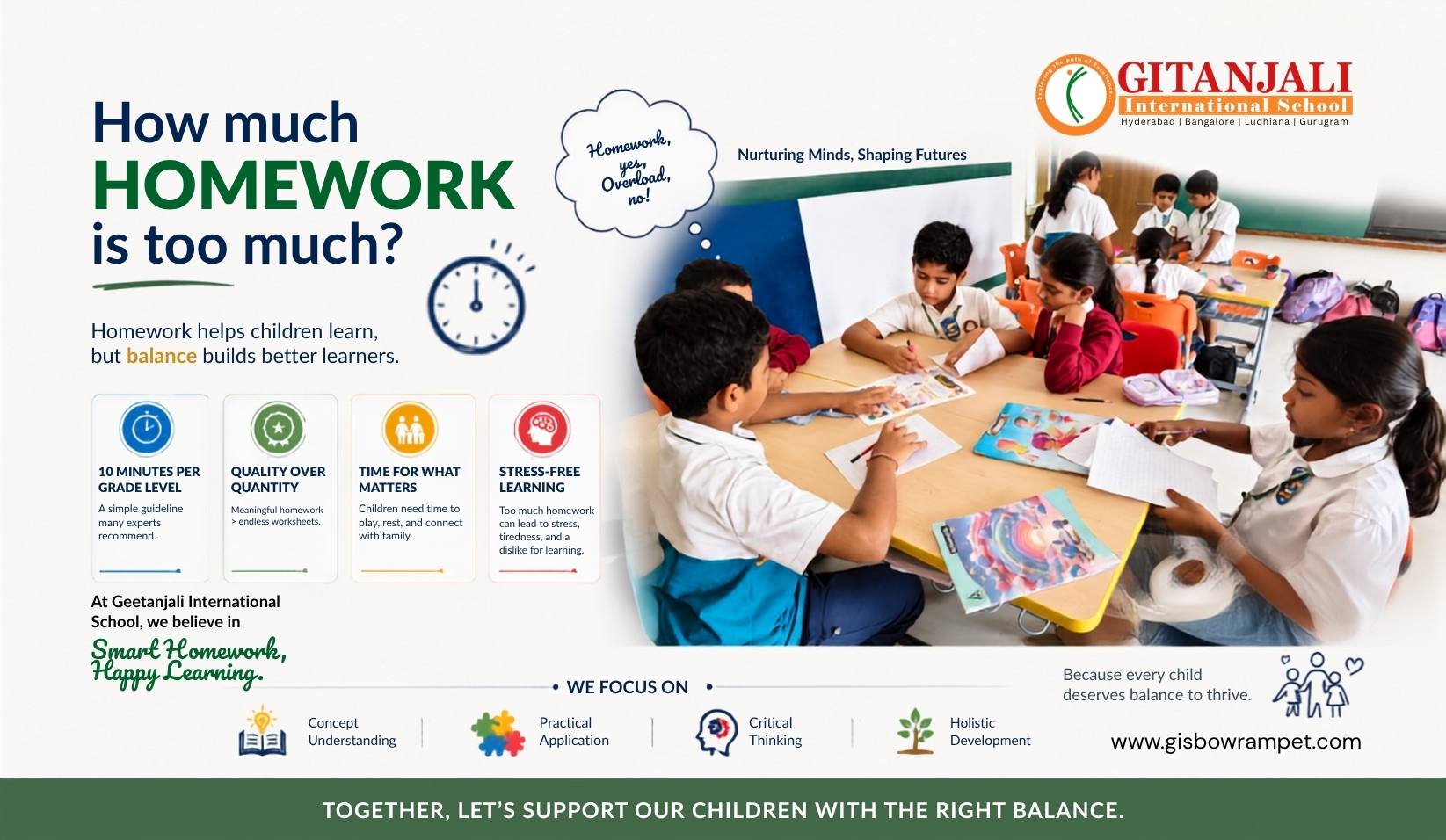
Teachers often talk about the “10-minute rule” — about 10 minutes of homework per grade level, per day. So:
- A Grade 1 kid: maybe 10 minutes
- A Grade 5 kid: closer to 50 minutes
- A Grade 10 student: around 90 minutes, give or take
If your child is spending double or triple that most nights, something’s off — either the workload needs revisiting, or the assignments aren’t as efficient as they could be.
The Warning Signs Parents Shouldn’t Ignore
You’ll usually notice it before anyone points it out to you:
- Homework routinely eating into bedtime
- Your child losing interest in things they used to enjoy — sports, drawing, just messing around
- Constant tiredness or dread before school
- Weekends that feel more like extended homework sessions than actual rest
If two or three of these sound familiar, it’s worth having an honest conversation with the school.
Why the Cambridge Curriculum Handles This Differently
One thing I genuinely appreciate about the Cambridge curriculum is that it leans toward depth over volume. Instead of piling on worksheets, it pushes kids toward projects, research, and thinking through problems — work that actually sticks, instead of busywork that gets forgotten the next day.
At Gitanjali International School in Bowrampet, this shows up in how homework is actually structured. Assignments are meant to reinforce what’s taught in class, not replace family time or downtime. Kids still get their evenings for sports, hobbies, or simply doing nothing — which, honestly, is just as important for growing minds. It’s part of why so many families searching for the best Cambridge school in Bowrampet keep coming back to this school when they compare options.
The Real Alternative: Experiential Learning
Honestly, a lot of the “extra” homework schools hand out is just an attempt to make sure a concept sticks in a child’s head. Fair enough, that’s the goal. But there’s a better way to get there, and it doesn’t mean more worksheets stuffed into a school bag.
Experiential learning, put simply, is learning by doing. Instead of loading kids with take-home assignments, a lot of the names you’ll find when you search for the best Cambridge school in Bowrampet are now putting their energy into hands-on activities during school hours. What does that actually look like day to day? A few examples:
- Take science. A child who builds a working volcano model, or grows their own crystals in a jar, is going to remember that lesson years down the line. Compare that to a kid who just copied down notes off a whiteboard. There’s no contest, really.
- Or math. Instead of ten repetitive sums for homework, have the kids plan a mock grocery trip on a fixed budget, or go outside and measure the school garden. Same concepts — fractions, measurement — but it actually means something to them.
- Field tripsdo a lot of heavy lifting too. A trip to a science museum, a nearby farm, or even a local historical site turns something abstract from a textbook into a memory the child can picture. You’d be surprised how much a kid retains from one good field trip compared to a week of homework on the same chapter.
- Group work matters as well — debates, mock parliaments, acting out a scene from a history lesson. Kids build understanding this way, sure, but they also build the confidence to actually speak up in front of others, which honestly matters just as much.
- Then there’s the creative Pairing a bit ofart, music, or craft with a lesson — say, drawing a scene from a story they just read — reinforces language and comprehension without it feeling like homework at all. It just feels like fun, which is sort of the point.
And gardening deserves a mention too. Kids planting something and actually taking care of it teaches biology and a sense of responsibility in a way no textbook chapter can.
Schools that build their day around this kind of learning usually end up needing less homework overall — the concept’s already sunk in through experience, not repetition. And that, more than anything, is what separates an average school from one that gets recognized as the best international school in Bowrampet. It’s not just what’s in the syllabus. It’s how that syllabus actually reaches the child sitting in the classroom.
What Parents Can Actually Do
A few things that genuinely help:
- Stick to a homework routine, but build in breaks
- Don’t compare your child’s workload to a neighbour’s or cousin’s — every child works at their own pace
- Talk to teachers directly if the load feels heavy — most are open to it
- Protect time for play, rest, and family, not just study
- When choosing a school, ask about their homework philosophy upfront, not after enrolment
At the End of the Day
Homework should support learning, not swallow childhood whole. As a parent, it’s worth paying as much attention to a school’s approach to workload as you do to its results or facilities. Schools that get this balance right — and Gitanjali International School is a good example among those recognized as the best international school in Bowrampet — tend to raise kids who actually enjoy learning, instead of just enduring it.